The 1-Bag Method: Engineering Logistical Sovereignty
In the theater of global exploration, the most profound technical advantage a soloist can possess is not a high-limit credit card or a diplomatic passport, but a weightless logistical footprint. For the SoloLife practitioner, a checked suitcase is more than an inconvenience; it is a tactical liability that compromises the OODA Loop (Observe, Orient, Decide, Act), tethering the individual to baggage carousels, transit queues, and the predatory economics of the travel industry.
This manual serves as the definitive technical deconstruction of the 1-Bag Method. We will move beyond the superficial "packing tips" common in lifestyle media to analyze the biomechanics of load-bearing, the textile science of high-performance fibers, and the psychological architecture of essentialism. By mastering the 40-liter shell, you transform from a "tourist" burdened by inventory into a Kinetic Traveler—capable of moving from a transatlantic flight to a mountain trailhead without stopping at a hotel. This is the blueprint for total mobility.

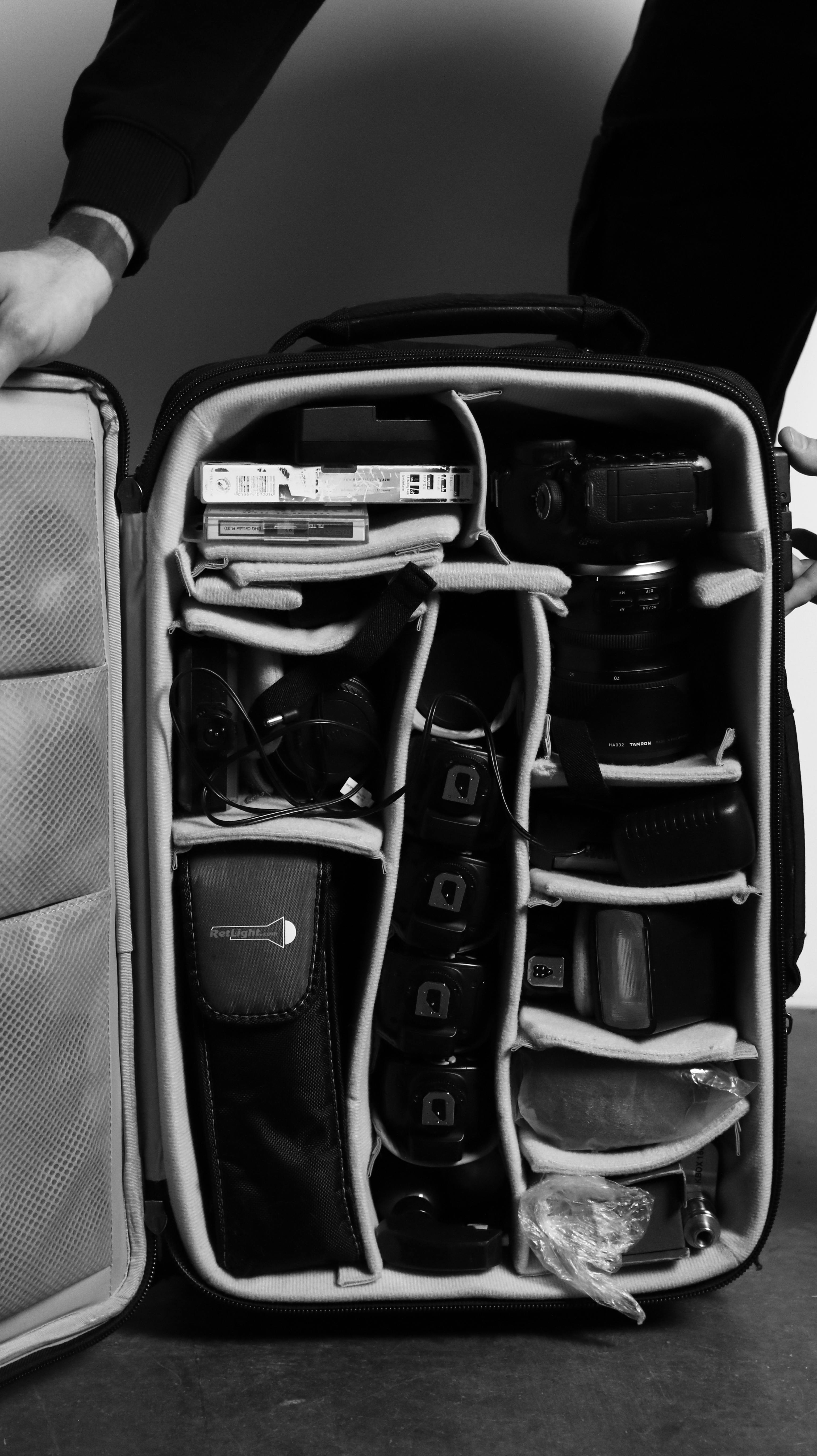
A perfectly organized 40L technical backpack showcasing the peak of minimalist logistical engineering
1. The Psychology of Inventory Anxiety: Deconstructing the "Just-In-Case" Syndrome
To engineer a minimalist luggage system, one must first confront the evolutionary hardware that drives overpacking. Biologically, humans are "hoarding organisms." For 300,000 years, an extra skin, a spare tool, or a surplus of rations meant the difference between survival and expiration. In the 21st century, this survival instinct manifests as Inventory Anxiety—the irrational fear that a lack of physical possessions in a foreign environment constitutes a threat to safety.
The Loss Aversion Trap
Cognitive psychologists identify this as a form of Loss Aversion. We overvalue the potential utility of an item we might need over the guaranteed cost of carrying that item for 14 days. The "Just-In-Case" (JIC) items—the third pair of shoes, the heavy formal jacket, the industrial-sized medicine kit—act as psychological security blankets.
In reality, most JIC items represent a failure of Environmental Intelligence. With the exception of deep-wilderness expeditions, almost any missing item can be sourced locally at the destination. By carrying these "Ghost Assets," you are paying a permanent metabolic and logistical tax. To achieve the 1-Bag state, you must replace Inventory with Resourcefulness. You must trust your ability to solve problems through action rather than through a pre-packed object. This psychological shift is the prerequisite for the Solo Safety Audit; if you cannot secure your own mental state against the fear of lack, you cannot secure your physical person in a foreign environment.
2. The 40L Shell Architecture: Biomechanics of the Modern Carry-On
The choice of the "Shell"—the backpack itself—is an exercise in Structural Engineering. A bag is not a container; it is a wearable suspension system. For a 14-day solo adventure, the global consensus among elite travelers, including the pioneers at OneBag.com↗, is a volume of 35L to 45L. This range represents the maximum allowable dimensions for international carry-on regulations (typically 55 x 35 x 20 cm).
Clamshell vs. Top-Loader
From a logistical throughput perspective, the Clamshell (Front-Loading) design is technically superior to the traditional hiking top-loader. A clamshell opening allows for total visual access to the internal inventory, enabling the retrieval of any item without disturbing the rest of the stack. This minimizes "Search Entropy" and allows for rapid packing/unpacking during high-stress transit windows.
Suspension and Load Dynamics
A high-performance shell must include:
- The Internal Frame: Usually a HDPE (High-Density Polyethylene) sheet or aluminum stay that prevents the bag from "barreling" and transfers the weight to the hips.
- Load Lifters: Critical straps above the shoulders that pull the bag’s center of gravity closer to the spine, reducing the torque on the lower back.
- Padded Hip Belt: In a 40L system, 80% of the weight should be carried by the iliac crest (hips), not the shoulders.
By optimizing the Kinetic Linkage between the bag and the body, you reduce the physiological fatigue of travel, preserving your "Decision Energy" for the complex cultural navigation required when you Travel Luxury on a Solo Budget.
3. Textile Science 101: Molecular Defense and Durability
The 1-Bag Method relies on Material Superiority. Because you are carrying fewer items, each item must perform at a higher technical level. We categorize materials into two pillars: The Shell (Durability) and The Layer (Performance).
High-Tenacity Synthetics
The exterior of your bag should be constructed from Cordura 500D or X-Pac. These fabrics utilize high-tenacity nylon 6,6 filaments. X-Pac, originally developed for sailcloth, features a multi-layer laminate that is 100% waterproof and has a high "Tear Strength-to-Weight" ratio. This ensures your inventory is sequestered from the atmospheric elements and the kinetic abuse of global baggage handling.
Merino Wool: The Antimicrobial Alpha
For clothing, Merino Wool is the non-negotiable standard. At a molecular level, Merino fibers are composed of keratin proteins that naturally inhibit the growth of odor-causing bacteria. Unlike polyester, which "traps" lipids and salts, Merino can be worn for 3-5 days in high-heat environments without a detectable bacterial load.
- The Crimp Factor: The natural curl (crimp) of the fiber creates microscopic air pockets that provide Thermoregulation, keeping you cool in the desert and warm in the aircraft cabin.
- GSM (Grams per Square Meter): For the 1-bagger, we look for 150-180 GSM for shirts and 200-250 GSM for mid-layers.
Close-up of high-tenacity X-Pac laminate and weather-sealed YKK zippers
4. The Capsule Wardrobe Algorithm: Combinatorics of Style
Packing for 14 days with only 12 items is not a magic trick; it is a Combinatorial Algorithm. In a 1-Bag system, every item must be "Compatible" with every other item. We call this the Monochromatic Uniform.
The 5-4-3-2-1 Formula
A standard solo-travel algorithm involves:
- 5 Tops: (2 Merino Tees, 1 Long Sleeve, 1 Technical Button-Down, 1 Polo).
- 4 Bottoms: (1 Chino, 1 Technical Pant, 1 Short, 1 Swim Trunk).
- 3 Layers: (1 Down Puffy, 1 Rain Shell, 1 Mid-layer).
- 2 Shoes: (1 Technical Sneaker worn, 1 Minimalist Sandal packed).
- 1 Accessory Set: (7 pairs Merino socks/underwear).
By selecting a base color (Navy or Black) and an accent color (Grey or Olive), you create a matrix of 20+ unique outfit combinations from just 12 pieces. This removes the Decision Fatigue of "what to wear," allowing you to focus on the cultural immersion of the destination.
5. Modular Organization: The Cube Audit and Volume Arbitrage
To fit a 14-day wardrobe into a 40L shell, you must eliminate the Empty Space between garments. We achieve this through Modular Compression Units (Packing Cubes).
Compression vs. Organization
Standard cubes provide organization; Compression Cubes (using a secondary perimeter zipper) provide Volume Arbitrage. By mechanically removing the air from the fabric, you increase the "Inventory Density" of your bag by 30%.
- The Tetris Protocol: Assign one cube for "Dirty" and one for "Clean." This creates a internal firewall, preventing the cross-contamination of moisture and odors.
- Weight Distribution: Heavy cubes (shoes/tech) should be placed at the bottom-center of the bag, closest to your back, to maintain a neutral center of gravity.

Organized packing cubes being inserted into a clamshell backpack representing modular precision
6. The Rule of Three: Engineering the Laundry Protocol
The secret to 1-Bag travel is not a bigger bag; it is a Functional Laundry System. If you refuse to wash clothes, you must carry 14 of everything. If you embrace the Rule of Three, you only need three.
The Cycle of 3
- The One You Wear: Active use.
- The One You Wash: In the sink/machine.
- The One That Dries: Recovering on the line.
Using a concentrated, biodegradable soap (like Dr. Bronner’s), a 10-minute sink wash before bed ensures that your quick-dry technical gear is ready by morning. This daily maintenance is the same "discipline of the small" required for Bodyweight Mastery—the refusal to let the environment dictate your standards of hygiene or fitness.
7. Technology Sequestration: Minimizing the Digital Load
In 2026, the heaviest part of a traveler's bag is often the "Digital Junk Drawer." To maintain kinetic mobility, you must apply Technology Sequestration.
The GaN Advantage
Replace five power bricks with a single 100W GaN (Gallium Nitride) charger. These chargers use high-frequency switching to provide massive power output in a housing 50% smaller than silicon chargers. Pair this with a single high-bandwidth USB-C cable for your phone, laptop, and camera.
- e-Ink Transition: Replace your physical library with a single Kindle.
- Cloud Redundancy: Store your Solo Safety Audit documents in an encrypted vault rather than carrying paper copies.
8. Logistical Time Arbitrage: The Speed of Light Travel
The ROI of the 1-Bag method is measured in Minutes.
- Airport Ingress/Egress: By skipping the check-in counter and the baggage carousel, you reclaim 90 minutes per flight.
- The "Last Mile" Advantage: When you arrive in a new city, you don't need a taxi to your hotel. You can walk, take the train, or hop on a scooter. You are a sovereign agent, moving at the speed of thought.
This Time Arbitrage funds your ability to explore "Hidden Gems" that the suitcase-burdened crowd will never see. You are trading physical weight for cultural opportunity.
9. The Weightless Philosophy: Cognitive Focus and Solitude
There is a direct neurological correlation between your physical weight and your mental clarity. This is a core tenet of the Science of Solitude. When you are not constantly monitoring a 25kg suitcase, your brain’s Default Mode Network is free to process the sensory inputs of the environment.
Lightness of bag leads to Lightness of Mind. You become less of a "target" and more of an "observer." You are no longer managing a logistical crisis; you are inhabiting an experience. This is the ultimate goal of the 1-Bag Method: to make the hardware of travel disappear so that the software of life can run at maximum resolution.
10. Sovereign Exploration: The Final Protocol
The 1-Bag Method is not about deprivation; it is about Sovereignty. It is the refusal to let objects define your boundaries. By mastering the 40L shell, the capsule wardrobe, and the laundry protocol, you have engineered a life that is ready for any destination, at any time.
Pack light. Move fast. Live deep.
The Spiderweb: Internal Connections
- *Secure your solo sanctuary before you leave with the Solo Safety Audit.*
- *Use your reclaimed budget to Travel Luxury on a Solo Budget.*
- *Maintain your physical peak anywhere with Bodyweight Mastery.*
Authoritative references for this logistical manual include OneBag.com↗, Patagonia's Gear Guides↗, and TSA Carry-on Standards↗.