Micro-Apartment Magic: The Technical Manual for Spatial Arbitrage and Interior Engineering
In the contemporary urban landscape, density is often perceived as a constraint. However, for the sovereign solo resident, a micro-apartment represents the ultimate challenge in Spatial Arbitrage. We are witnessing a shift in the philosophy of habitation where square footage is no longer a metric of status, but rather a variable to be engineered. When you occupy a space of 300 square feet alone, you are the sole curator of its atmospheric pressure, its kinetic flow, and its neurological impact.
This super-pillar article functions as a technical manual for the independent professional. We move beyond the superficial "decorating tips" found in mass-market media to analyze the architectural physics and environmental psychology required to make a limited footprint feel like an expansive mansion. By utilizing Environmental Priming, Kinetic Modularism, and Vertical Arbitrage, we will deconstruct how to transform a high-density studio into a high-performance sanctuary.

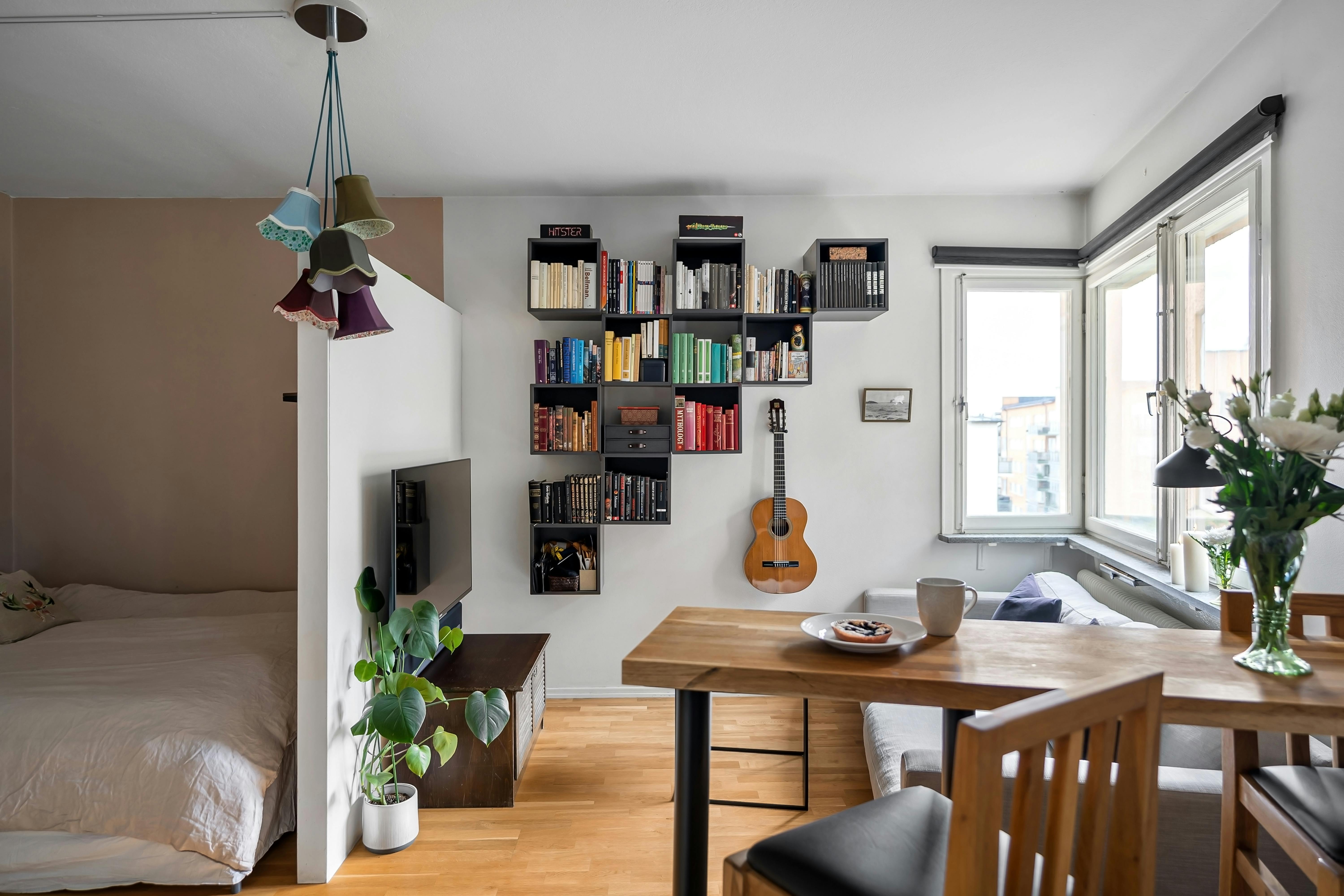
A high-end micro-apartment sanctuary engineered for rest, focus, and radical independence
1. The Neurobiology of Spatial Compression: Combatting the Amygdala Hijack
The human biological response to confined spaces is rooted in evolutionary survival. According to The Journal of Environmental Psychology↗, "Spatial Compression"—the perception of being boxed in—triggers the amygdala, the brain's threat-detection center. When the walls feel too close, the body maintains a baseline level of cortisol, leading to chronic low-level stress and a decrease in executive function. For the solo resident, whose home must also serve as a cognitive laboratory, this biological drag is unacceptable.
Engineering "Visual Breathability"
The solution lies in creating Visual Breathability. This is not about the physical distance between walls, but the perceived volume of air available to the eye. In a micro-apartment, the brain calculates "Freedom of Movement" based on how many unobstructed surfaces are visible. If your floor is covered in furniture and your walls are crowded with dark cabinets, your brain registers "Clutter," which it translates into "Threat."
To mitigate this, we apply Low-Profile Engineering. By selecting furniture that sits low to the ground and utilizing monochromatic color palettes that match the wall color, we "recede" the objects into the background. This allows the eye to travel further before hitting an obstacle, effectively lowering the firing rate of the amygdala and reclaiming the cognitive bandwidth needed for your Solo Morning Ritual.
2. The Sightline Rule: Engineering the Gaze Path to Double Perceived Depth
Architects at the MIT Media Lab (CityScience)↗ have long studied how the human eye perceives depth in urban environments. In a 300-square-foot micro-apartment, the most powerful tool you possess is the Sightline Rule. The feeling of "Mansion-like" expansiveness is a result of uninterrupted gaze traversal.
The Diagonal Advantage
In any square or rectangular room, the longest possible line is the diagonal. Most solo dwellers make the strategic error of placing furniture in a way that blocks the view of the far corners. This "truncates" the room, making it feel 20% smaller than its actual dimensions.
By keeping the sightlines to the corners of the apartment clear, you force the brain to register the maximum possible distance. This is Spatial Arbitrage: making the mind believe there is more air than there is.
- The Vanishing Point Protocol: Use mirrors or artwork at the far ends of these diagonal lines to create a "Visual Anchor" that pulls the eye through the space.
- Transparent Mediums: Utilize glass or acrylic (Lucite) for coffee tables or desks. This allows the gaze to pass through the object to the floor beyond, maintaining the continuity of the gaze path.

An open-plan studio demonstrating clear sightlines and visual traversal to maximize perceived square footage
3. Vertical Arbitrage: Reclaiming the High-Altitude "Dead Air"
Most solo residents calculate their space on a 2D plane—floor square footage. However, a 300-square-foot apartment usually contains between 2,400 and 3,000 cubic feet of volume. The space above six feet is typically "Dead Air"—an unutilized asset. Vertical Arbitrage is the act of moving your logistical inventory into the high-altitude zones to free up the "Kinetic Zone" (the floor).
High-Altitude Infrastructure
According to ArchDaily↗, the most efficient micro-homes in Tokyo and Paris utilize full-height cabinetry.
- The Library Lift: Run your shelving all the way to the ceiling. Even if you need a step-ladder to reach the top rows, the visual effect is one of "Grandeur." It emphasizes the height of the room, drawing the eye upward and away from the narrow floor.
- The Over-Door Secret: The space above doorways is often ignored. Installing a deep shelf here for off-season gear or "Inventory Assets" (refer to the Solo Financial Plan for asset management) removes clutter from your immediate peripheral vision.
By moving your "Storage Load" to the ceiling, you allow the floor to remain a "Performance Surface" for your Minimalist Home Gym.
4. The Leggy Furniture Rule: The Physics of Visual Weight
In micro-apartment engineering, we must distinguish between "Physical Weight" and "Visual Weight." A heavy, skirted sofa that sits flat on the floor act as a Spatial Vampire—it sucks up the visible floor area and creates a "Visual Dead End."
Floor Continuity
The Leggy Furniture Rule dictates that in small spaces, every piece of furniture—from the sofa to the bed frame—must be elevated on tapered legs.
- Why it works: When you can see the floor continuing underneath a piece of furniture, your brain counts that square footage as "Available Space."
- The Shadow Gap: Allowing light and air to circulate under your furniture creates a "Shadow Gap" that removes the feeling of heavy, immovable blocks. This psychological trick makes a studio feel like a mansion because the boundaries aren't "interrupted" by heavy blocks of wood or fabric.
This is the foundation of Modern Kinetics: choosing furniture that appears to "float," thereby reducing the cognitive load of navigating the apartment.

Mid-century modern furniture with thin legs, allowing the eye to perceive the continuous floor space beneath
5. Mirror Arbitrage: Using Light Bouncing to Delete Physical Boundaries
Mirrors are often dismissed as simple decor, but in the hands of a spatial engineer, they are Reflection Tools used to hack the laws of physics. Mirror Arbitrage involves placing reflective surfaces in positions where they "delete" walls by reflecting light and distant views.
The Window Multiplier
Place a large floor-to-ceiling mirror directly opposite your primary natural light source. This does two things:
- Light Saturation: It doubles the amount of "Natural Lux" in the room, which is critical for your Solo Morning Ritual and circadian health.
- Portal Logic: It creates a "Secondary Window." When the eye sees a reflection of the outdoors, it struggles to register the glass as a boundary, creating an illusion of depth that mimics a much larger, multi-windowed estate.
Strategic mirror placement can increase the "Perceived Volume" of a 300-square-foot room by up to 40% without adding a single physical inch.
6. Psychological Zoning: Engineering Rooms Without Walls
One of the greatest stressors of solo living in a studio is "Blur Fatigue"—the feeling that you are eating, working, and sleeping in the same square foot. To maintain elite mental health, you must implement Psychological Zoning. This involves using sensory cues to create "Mental Rooms."
The Triad of Zoning:
- Tactile Zoning (Rugs): A rug is a border. When your feet move from the wood floor to a high-pile rug, your brain receives a somatic signal: "I have entered a new room."
- Lighting Kelvin Shifts: Use 5000K "Cool White" for your Home Office corner to spike productivity, and 2700K "Warm Amber" for the sleeping area. This Chrono-Lighting protocol manages your cortisol levels based on which "Zone" you occupy.
- Olfactory Anchoring: Use specific scents for different zones. Citrus for the work zone; Sandalwood or Lavender for the rest zone.
By "hard-coding" these sensory triggers, you allow your brain to switch between roles (Executive, Creator, Restorer) with surgical precision, even in a single room.
7. Kinetic Modularism: The High-Performance Moveable Wall
In 2026, the static micro-apartment is obsolete. The high-performance solo professional utilizes Kinetic Modularism. This is the use of furniture that changes its function based on the time of day—effectively making your 300 square feet work like 600.
The Fluid Home
A bed that folds into a desk (The Murphy Pivot) or a "Moving Wall" system allows you to hide the "Rest Phase" of your life during the "Output Phase." As we discuss in The Science of Solitude, deep work requires an environment free from the visual cues of relaxation. By folding away your bed, you remove the "Lure of the Nap," forcing your brain into high-gear productivity. This is Mechanical Discipline—using your architecture to enforce your willpower.

Modern modular storage and kinetic furniture designed to hide logistical inventory
8. Chrono-Lighting: Circadian Management in Small Spaces
The solo professional is the sole guardian of their biological clock. In a micro-apartment, you are often exposed to the same light source for 16 hours a day. This leads to Circadian Desynchrony, which destroys sleep quality and focus.
The Kelvin Protocol
You must implement a Chrono-Lighting system using smart bulbs.
- 07:00 - 10:00: 6500K (Bright Blue-White). This mimics the high-noon sun, suppressing melatonin and priming the brain for your Skill Hour.
- 10:00 - 18:00: 4000K (Neutral White). Sustained focus for deep work.
- 18:00 - 22:00: 2700K (Warm Orange). Signals the onset of the parasympathetic "Repair Phase."
By automating this shift, your apartment becomes a biological regulator, ensuring you maintain the energy levels of a centenarian (refer to our Mediterranean Mindset guide).
9. The Decluttering Protocol: Inventory Arbitrage for the Home
A mansion feels large because of its empty space. A micro-apartment feels small because of its objects. To achieve "Mansion-feel," you must apply the Inventory Arbitrage found in The 1-Bag Method.
The "One-In-One-Out" Mandate
Every object in your solo home must justify its presence. If an item is not "Beautiful, Useful, or Scientifically Necessary," it is Spatial Debt.
- The 90-Day Audit: Every quarter, perform a "Vulnerability Sweep." If you haven't touched an object in 90 days, it is moved to "Deep Storage" (Vertical Arbitrage) or liquidated.
- Digitalization: Convert your library to e-ink and your files to encrypted cloud storage. Physical paper is the greatest thief of square footage in the modern solo home.
10. The Sovereign Sanctuary: Turning the Micro-Apartment into a Lab
The final realization of the spatial engineer is this: Your micro-apartment is not a "home" in the traditional, domestic sense. It is a Sovereign Sanctuary—a high-performance laboratory designed for the curation of a legendary life.
The Synthesis of mastery
By applying the Sightline Rule, Vertical Arbitrage, and Psychological Zoning, you have moved past the constraints of your physical footprint. You are now living in an environment that supports your Science of Solitude. Your micro-apartment is no longer 300 square feet; it is a limitless portal to focus, health, and wealth. You have used architecture to unlock the best version of your independent self.
Reclaim your space. Reclaim your life. Live sovereign.
The Spiderweb: Internal Connections
- *Optimize your morning in your new sanctuary with The Solo Morning Ritual.*
- *Fund your micro-mansion upgrades via The Solo Financial Plan.*
- Train for peak performance in your elevated gym area with our Minimalist Home Gym guide.