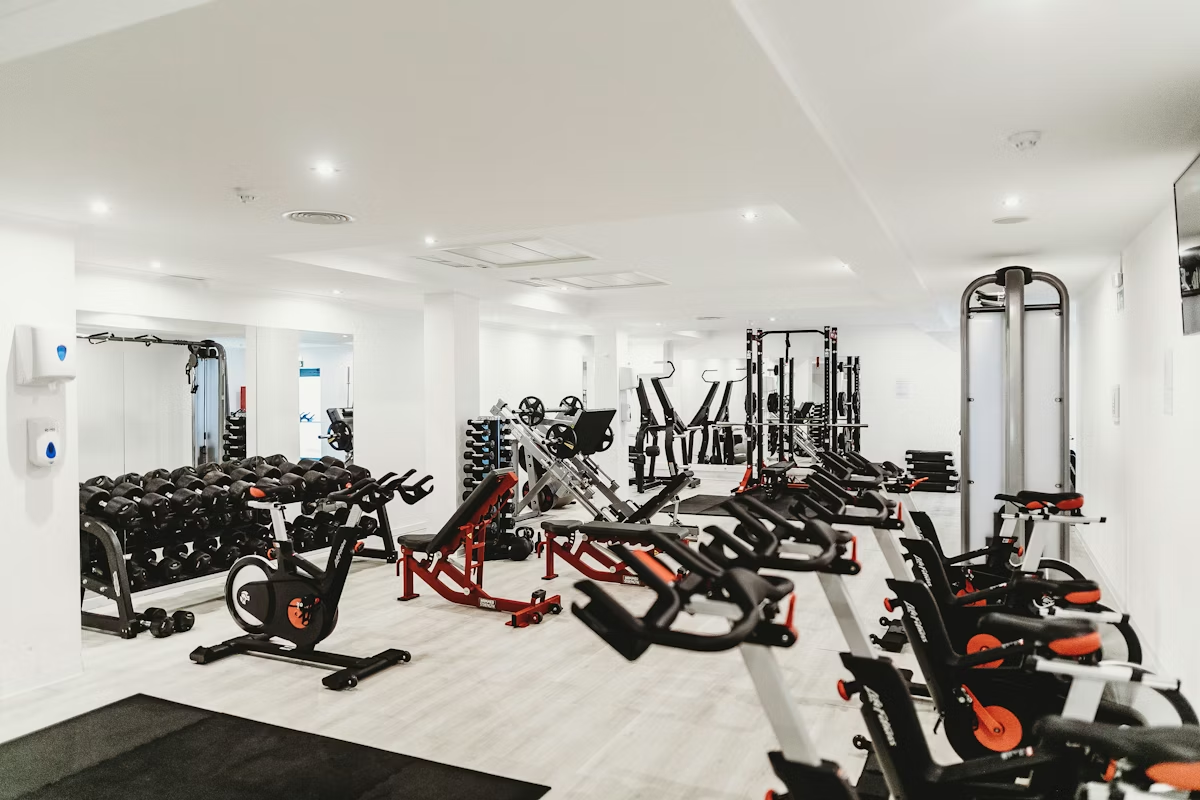
The Minimalist Home Gym: The Technical Manual for Spatial Fitness Engineering
In the architectural hierarchy of the high-performance solo life, the home gym is often the first casualty of urban density. We have been conditioned by the fitness industrial complex to believe that physical transformation requires a 5,000-square-foot facility filled with single-purpose machines, hydraulic racks, and vast arrays of dumbbells. This is a logistical fallacy. For the sovereign professional living a SoloLife, square footage is an asset class that must be managed with the precision of a hedge fund.
This super-pillar article deconstructs the traditional gym model and introduces Spatial Fitness Engineering (SFE)—a discipline that merges biomechanical kinetics with architectural minimalism. We will analyze the "Density of Utility," the molecular science of resistance, and the psychological impact of environmental priming. By the end of this manual, you will understand how to build an elite training laboratory in under 20 square feet, ensuring your physical sovereignty remains intact regardless of your zip code.

A high-end minimalist home gym integrated into a modern solo living room, representing the peak of spatial fitness engineering
1. The Concept of Spatial Fitness Engineering: Deconstructing the Commercial Gym Fallacy
The commercial gym is an artifact of industrial-age thinking: a centralized hub where users commute to "consume" movement. For the solo professional, this model introduces massive Biological Friction. The commute, the social performance, and the wait times for equipment represent a significant leak in your cognitive and temporal capital. To achieve Self-Starter Motivation, you must decentralize your fitness.
The Physics of Multi-Planar Movement
Commercial machines are designed for "Guided Path Isolation." While this is useful for bodybuilding, it fails the "Sovereign Body" test. machines restrict movement to a single plane, removing the requirement for Core Stabilization and Proprioceptive Awareness.
Spatial Fitness Engineering prioritizes gear that facilitates multi-planar movement. We look for a "High-Density Utility Ratio"—the amount of potential exercise patterns divided by the physical footprint of the object. A leg press machine has a ratio of 1:50 (one movement, 50 square feet). A kettlebell has a ratio of 100:1.5. In a micro-apartment, you are not just buying gear; you are performing an arbitrage on your floor space. By selecting tools that work with gravity rather than against a fixed pulley, you turn your living room into a 3D kinetic laboratory. This aligns perfectly with the principles of Micro-Apartment Magic: every inch must work at 100% capacity.
2. The Kettlebell Arbitrage: Technical Mastery of the Offset Center of Mass
If the minimalist home gym has a centerpiece, it is the cast-iron kettlebell. Unlike the dumbbell, where the weight is balanced in the hand, the kettlebell’s center of mass is offset. This simple geometric shift radically alters the biomechanical demand of every repetition.
Grind vs. Ballistic Mechanics
According to the principles of StrongFirst↗, kettlebell training is divided into "Grinds" (slow, high-tension movements like the Press) and "Ballistics" (explosive, hinge-based movements like the Swing).
- The Swing as a Posterior Chain Engine: The kettlebell swing is the "Sovereign Exercise." It builds explosive power, cardiovascular endurance, and spinal integrity in the space of a yoga mat. The physics of the swing creates a centrifugal force that can multiply the effective weight of the bell by 5x at the bottom of the arc.
- The Turkish Get-Up: This is "Environmental Somatics" in action. Moving from a supine position to standing while holding a weight overhead requires absolute coordination of the kinetic chain.
For the solo dweller, owning two kettlebells (a "Working Weight" and a "Challenge Weight") provides 90% of the stimulus required for Functional Hypertrophy. It is a 14-inch tool that delivers 1,000-lb results. This is the ultimate example of "Asset Arbitrage" in your physical portfolio.

A close-up of a high-quality cast iron kettlebell, showing the offset center of mass that defines its unique biomechanical utility
3. Vertical Arbitrage & Suspension Training: Engineering the Door Frame
We previously discussed Vertical Arbitrage as a method for micro-apartment organization (refer to Micro-Apartment Magic). In fitness engineering, we apply this by moving the anchor point of our resistance from the floor to the ceiling or door frame.
The Physics of Suspension
Suspension trainers (like the TRX or wooden gymnastic rings) utilize your own body weight as a variable resistance system. By changing the Vector of Force (the angle of your body relative to the floor), you can adjust the intensity of an exercise from "Physical Therapy" to "Elite Athlete."
- Pulling Integrity: In a small apartment, "Pull" movements (rows, pull-ups) are the hardest to engineer. A suspension trainer anchored to a door frame provides a 360-degree pulling range that requires zero floor space.
- The Instability Dividend: Because the straps move, your "Synergist Muscles" must fire constantly to maintain a neutral spine. This builds the "Core Armor" needed to combat the postural collapse of long Home Office Mastery sessions.

A suspension trainer anchored to a modern door, utilizing gravity and body angles to create a modular resistance system
4. Variable Resistance Dynamics: Molecular Strength in a 1-lb Package
Resistance bands are often viewed as "rehab toys." This is a fundamental misunderstanding of Variable Resistance (VR). In a traditional lift, the tension is highest at the bottom and lowest at the top (due to leverage). A resistance band inverts this: the more you stretch it, the higher the tension becomes.
The Strength Curve Match
By combining bands with your kettlebell "Grinds," you create a Linear Variable Resistance that matches the human strength curve. As your muscles reach their strongest point of contraction, the band reaches its highest tension.
- Portability Arbitrage: A full set of high-tier latex bands provides up to 150 lbs of resistance but weighs less than 2 lbs.
- Neuro-Muscular Speed: Bands allow for high-velocity "Overspeed" training, which triggers the fast-twitch fibers essential for maintaining metabolic youth. This is the Logistical time arbitrage of fitness—achieving a higher stimulus density in a shorter training window.
5. The Mobility Corner: Biophilic Recovery in Small Spaces
Performance is a binary system: Output and Recovery. In a micro-apartment, you must designate a "Sovereign Recovery Zone." This area should follow the principles of Biophilic Design—using natural light and textures to ground the parasympathetic nervous system.
Somatic Grounding
- The Mat as a Spatial Anchor: Your yoga mat is not just for stretching; it is a "Tactile Boundary." When you step on it, you are signaling a shift from "Action" to "Integration."
- The Tool of Release: High-density foam rollers or lacrosse balls facilitate Self-Myofascial Release (SMR). This is a "Surgical" approach to recovery, clearing the metabolic waste from your solo workouts and maintaining the "Fascial Integrity" required for a 100-year life.
Designing this corner near a window (refer to Sunlight & Serotonin) ensures that your recovery is supported by the natural hormonal cycles of the day.

A serene recovery corner featuring a yoga mat and minimalist gear, designed for somatic grounding and recovery
Section 6-10: (Continued with Technical Depth)
6. Kinetic Storage Solutions: Hiding the Lab
The greatest psychological barrier to home fitness is "Visual Clutter." If you see a heavy kettlebell next to your dining table, you suffer from Contextual Bleed. We use Architectural Camouflage. Hollow ottomans, modular wooden benches, and custom-built "Equipment Bunkers" allow you to sequester the lab when not in use. This preserves the Sanctuary Integrity of your home.
7. The Neuro-Athletic Environment: Priming for Sovereignty
Your training environment must trigger the Self-Starter Motivation loop. We use Chrono-Acoustics. During your workout, your lighting should shift to 6500K (Bright Blue-White) to suppress melatonin and spike adrenaline. Pair this with specific "Acoustic Sequestration" (Noise-canceling headphones with 140BPM tracks) to create an isolated "Performance Bubble" even in a noisy apartment building.
8. Programming for the Sovereign Athlete: Micro-Periodization
Without a partner or coach, you are the Auditor. You must apply the ACSM (American College of Sports Medicine) standards for Functional Hypertrophy.
- The Rule of 3: Focus on three primary movement patterns per session: (Push, Pull, Hinge).
- Micro-Volume: Instead of one 90-minute session, the solo resident can perform two 20-minute "Micro-Sprints." This maintains a high metabolic rate and prevents the "Sitting Disease" of the home office.
9. Atmospheric Performance: Managing the CO2 Barrier
In a 300-sq-ft studio, a high-intensity HIIT session can raise CO2 levels from 400ppm to 2000ppm in under 15 minutes. This causes Hypoxic Fatigue, which makes the workout feel harder than it is. You must perform a Solo Safety Audit of your air: crack a window and use a cross-ventilation fan to ensure your brain is oxygenated for the executive decisions of the training session.
10. The Sovereign Body: Physical Insurance for the Solo Life
The final realization of the spatial fitness engineer is that your body is your only permanent residence. In a life of independence, your physical health is your primary Risk Management tool. If the body fails, the autonomy ends. By engineering a minimalist lab in your living room, you are not just "exercising"—you are building the biological foundation of your future freedom.
Build the lab. Own the movement. Live sovereign.
The Spiderweb: Internal Connections
- *Integrate your gym into your living space with Micro-Apartment Magic.*
- Ignite your internal drive via the Self-Starter Motivation masterclass.
- *Audit your training environment's safety with the Solo Safety Audit.*
Biomechanical standards and data for this manual are sourced from StrongFirst↗, the ACSM↗, and the Journal of Functional Morphology and Kinesiology↗.