The Single-Serve Cookie: The Technical Manual for Molecular Emulsification and Portion Arbitrage
In the architectural hierarchy of the high-performance solo life, the kitchen serves as both a biological refueling station and a source of significant cognitive friction. For the independent professional, the desire for an organoleptic reward—specifically, a high-quality dessert—often collides with the legacy systems of industrial baking. Traditionally, recipes are optimized for the "Mass Batch," yielding 24 to 36 units. For the solo resident, this creates a catastrophic failure in portion management, leading to either systemic food waste or, more commonly, a state of hyper-palatable overconsumption that compromises metabolic health.
This manual introduces the Single-Serve Protocol. By treating the baking process as a micro-scale chemical reaction rather than a domestic chore, we can engineer a single "Unit of Hedonism" that satisfies the brain's reward centers while maintaining strict biological sovereignty. We will analyze the molecular binder mechanics of lecithin, the convection physics of high-velocity air, and the behavioral economics of Portion Arbitrage. This is the definitive guide to reconciling gourmet pleasure with the precision of SoloLife OS.

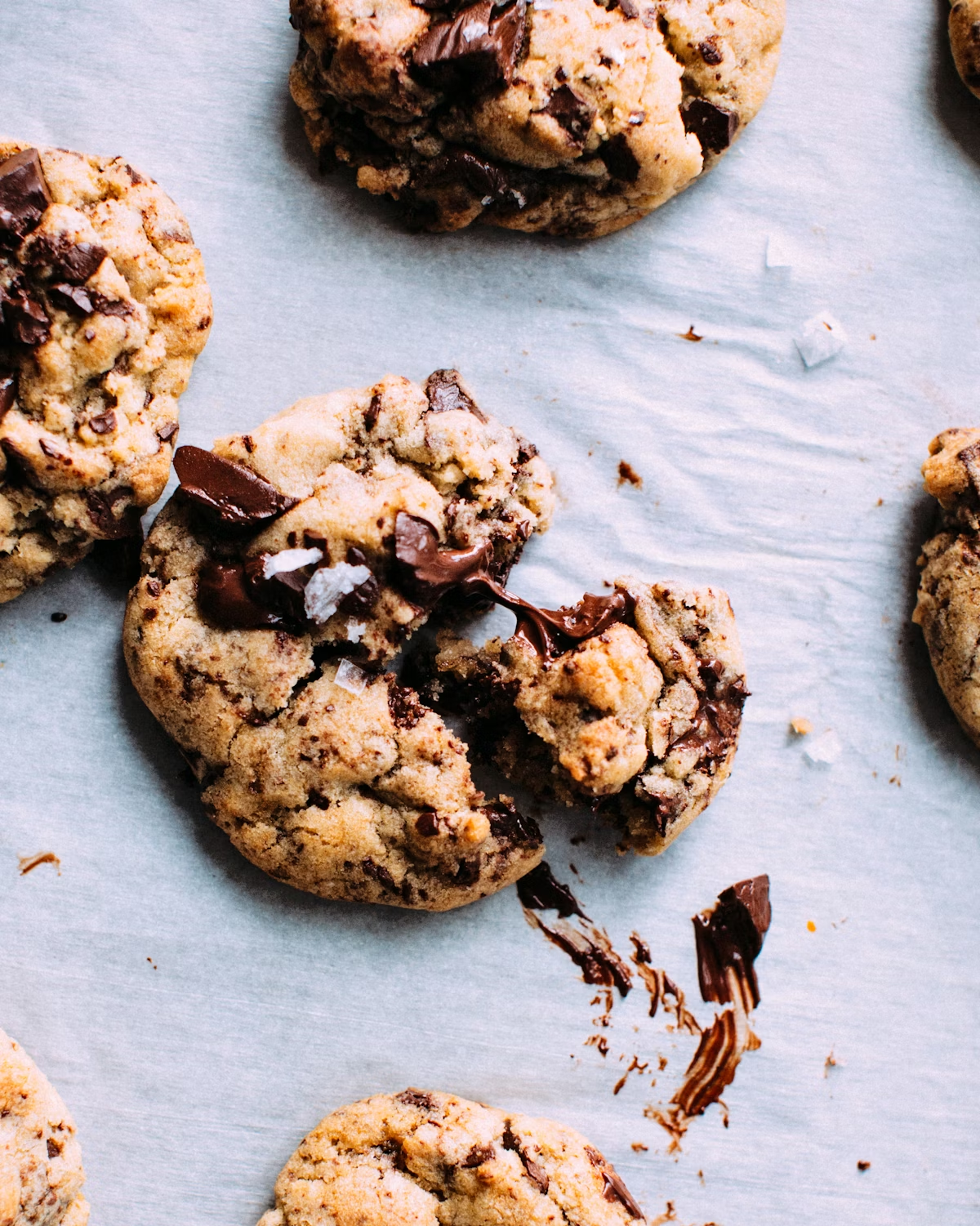
A singular, professionally engineered chocolate chip cookie representing the peak of portion arbitrage and culinary focus
1. The Solo Sugar Paradox: Biological Mismatch in the Modern Kitchen
The "Solo Sugar Paradox" refers to the physiological and logistical tension between the human drive for concentrated energy (sugar and fats) and the environmental structure of the modern kitchen. Historically, the culinary arts have been designed for the communal table. Baking, in particular, relies on "Economies of Scale." The energy required to preheat a large conventional oven and the physical volume of standard ingredients (like a single large egg) have mandated the production of multiple servings.
For the solo professionnel, this batch size is an economic and biological liability. When 24 cookies exist in the environment, the "Availability Heuristic" takes over. The brain, perceiving an abundance of high-caloric resources, downregulates satiety signals. This is often exacerbated by the Decision Fatigue accumulated throughout a high-output workday. By the time evening arrives, the willpower necessary to resist twenty-three "extra" cookies is metabolically depleted.
The solution is not deprivation, but the engineering of the Unit Dose. By shifting the production scale to 1:1, we eliminate the need for willpower. We move from a state of "restraint" to a state of "systemic compliance." According to research published in The American Journal of Clinical Nutrition↗, environmental control is 400% more effective than self-control for long-term weight management. The single-serve cookie is the physical manifestation of this environmental control.
2. Neuroscience of the Craving: Deconstructing the Mesolimbic Pathway
To master portion arbitrage, one must understand the neuro-chemical origins of the "Sweet Tooth." The human brain’s reward system is centered in the Mesolimbic Dopamine Pathway. When we anticipate a combination of lipids and sucrose, the Ventral Tegmental Area (VTA) releases dopamine into the Nucleus Accumbens. This is the "Pursuit Phase" of the craving.
The Hedonic Treadmill vs. Targeted Satisfaction
Traditional large-batch baking often triggers the "Hedonic Treadmill." Because the stimulus is abundant, the brain’s receptors become temporarily desensitized, requiring more units to achieve the same dopaminergic peak. This leads to the "Binge Cycle" common in solo dwellers who use food as a proxy for social co-regulation.
The Single-Serve Protocol utilizes Sensory-Specific Satiety. By preparing one high-tier unit with elite ingredients (Beurre Noisette, 70% Cacao), we maximize the "Signal-to-Noise" ratio of the reward. We use Mindful Breathing to manage the initial impulsive surge of the craving, allowing the prefrontal cortex to remain in control during the 10-minute preparation phase. This creates a "Ritualized Consumption" model that provides a higher neurological ROI than mindless bingeing.
3. Molecular Emulsification: The Physics of the Single Yolk
The most significant technical hurdle in micro-batch baking is the Egg Variable. A standard large egg weighs approximately 50 grams. Attempting to divide this by 24 for a single cookie is mathematically feasible but culinarily impossible without laboratory-grade scales.
Lecithin as the Primary Binder
In the Single-Serve Protocol, we abandon the "Whole Egg" model. The egg white is primarily water and albumin, providing structure and volume—attributes required for a mass of cookies but detrimental to the fudgy, dense profile of a singular masterpiece. Instead, we utilize the Egg Yolk alone.
The yolk is a biological powerhouse of Lecithin, a phospholipid that acts as a high-performance emulsifier. Lecithin possesses an amphiphilic nature: one end of the molecule is attracted to water (hydrophilic), and the other to fat (lipophilic). In a micro-batch environment, the yolk binds the melted butter and the sugars into a stable, viscous matrix. This prevents "Leaching," where the fat separates from the flour during the rapid heat transfer of the air fryer. The result is a texture that mimics the "Center-Cut" of a professional bakery cookie—pure molecular harmony.

Raw high-quality ingredients including farm-fresh egg yolks and organic flour representing the chemistry of the bake
4. Micro-Leavening Kinetics: Scaling the CO2 Release
Leavening is the process of generating carbon dioxide (CO2) gas to create "lift" and "crumb" in a dough. In standard baking, this is achieved through the reaction of sodium bicarbonate (baking soda) with an acid, or through the thermal decomposition of baking powder. At the micro-scale, the margin for error is nearly zero.
The Acidic Trigger
Because we are working with a single unit, we cannot rely on the "Volume Averaging" that occurs in a large bowl. We must ensure an immediate chemical trigger. We use a "Pinch" (approximately 1/16th of a teaspoon) of baking soda. To activate this in a dough that has minimal moisture, we rely on the lactic acid found in Dark Brown Sugar (molasses) and the vanillin compounds in high-tier extracts.
This interaction must occur at the Molecular Interface. Over-mixing the dough at this stage can lead to "Tunneling"—where the CO2 escapes before the structure is set by the heat. We aim for a "Low-Friction Fold," preserving the microscopic air pockets that will expand during the convection phase. This is the same principle of "Calculated Friction" we apply to Micro-Apartment Magic: using precisely enough resistance to achieve the desired structural outcome.
5. Thermodynamic Efficiency: Conventional Oven vs. Rapid Convection
A massive conventional oven is a thermodynamic dinosaur. To bake a single 50g cookie, you must heat approximately 3 cubic feet of air and the metal infrastructure of the oven rack. This results in a "Thermal Efficiency Ratio" of less than 0.1%. For the solo resident focused on Energy Sovereignty, this is an unacceptable waste of resources.
Heat Transfer Coefficients in the Air Fryer
The Air Fryer is the superior tool for the Single-Serve Protocol. It utilizes Rapid Convection Physics. By moving heated air at high velocities in a compact chamber (less than 0.2 cubic feet), the air fryer achieves a significantly higher Heat Transfer Coefficient than a static oven.
- Reduced Ramp-up: The air fryer reaches 160°C (320°F) in under 120 seconds.
- Surface-to-Volume Optimization: The high-velocity air strips the "Moisture Boundary Layer" from the surface of the cookie faster, accelerating the Maillard reaction (see section 6).
- Core Protection: Because the exterior sets so rapidly, the interior remains protected from over-drying, resulting in the "Molten Core" that is the hallmark of elite solo baking.

A modern air fryer chamber representing high-velocity convection physics
6. Maillard Kinetics in Micro-Batches: Engineering the Bakery Profile
The primary objective of the Single-Serve Protocol is to achieve the "Bakery Profile": a high-contrast experience where the perimeter is a rigid, caramelized lattice and the interior is a soft, semi-fluid matrix. This is achieved by manipulating Maillard Kinetics.
As we discussed in our manual on Gourmet Toasts, the Maillard reaction is a chemical interaction between amino acids and reducing sugars. In a single-serve cookie, we accelerate this by using Lipid Conductivity. By coating the chocolate chunks and the perimeter of the dough ball in browned butter, we provide a medium that conducts heat faster than air alone.
In the 8-minute air-fryer window, the exterior temperature exceeds 150°C, triggering the Maillard cascade. Simultaneously, the sugars undergo Caramelization, creating the complex, nutty aromatic profile that signals "Gourmet Quality" to the brain. Because the duration is so short, the "Carry-over Cooking" that occurs once the cookie is removed from the heat is what actually finishes the interior, preventing the rubbery texture often found in "microwave" single-serve recipes.
7. Ingredient Engineering: Beurre Noisette and Cacao Arbitrage
In the economy of one, you have the financial freedom to buy the best. Because you are only making one unit, the "Cost per Serving" remains low even when using the world’s finest ingredients. This is Ingredient Arbitrage.
Beurre Noisette (Browned Butter)
We do not use solid butter; we use Beurre Noisette. By heating butter until the milk solids toast and the water evaporates, you create a concentrated lipid source that is 100% fat. This removes the "Steam Variable" from the bake, leading to a denser, more intense flavor profile.
- The Satiety Signal: High-quality lipids trigger the release of Cholecystokinin (CCK) in the gut, which sends a powerful satiety signal to the brain, ensuring that one cookie is truly enough.
Cacao Solids
We mandate the use of 70% Dark Chocolate Chunks. Milk chocolate is too high in sucrose, which can trigger a "Sugar Spike-and-Crash" loop that ruins evening productivity. The bitterness of high-cacao solids provides a sophisticated sensory counterpoint, engaging more taste receptors and slowing down the speed of consumption.
8. The Single-Serve Protocol (The Blueprint)
This is the technical execution of the 10-Minute Dark Chocolate Chunk. This protocol is designed for integration into your Batch Cooking 2.0 workflow.
The Setup (By Weight):
- Lipid Phase: 15g Beurre Noisette (Warm).
- Sucrose Phase: 20g Dark Brown Sugar + 5g White Sugar (for edge crisping).
- Emulsifier: 1 Large Egg Yolk.
- Dry Matrix: 35g All-Purpose Flour + 1g Sea Salt + 0.5g Baking Soda.
- The Unit of Hedonism: 20g 70% Dark Chocolate (Roughly chopped).
The Execution:
- Micro-Mix: Whisk the lipid and sucrose phases until the mixture resembles wet sand.
- Emulsify: Add the yolk and whisk vigorously for 45 seconds until the mixture lightens—this indicates the lecithin has fully bonded the fats and sugars.
- Incorporate: Fold in the dry matrix and chocolate. Stop the moment no dry flour is visible to preserve the Gluten Lattice.
- Convection: Shape into a tall ball. Air-fry at 160°C (320°F) for exactly 8 minutes.
- Crystallization: Remove and let rest for 5 minutes. This rest period is non-negotiable; it allows the starches to set and the sugars to recrystallize into a crisp shell.

The finished product showing the molten center and Maillard-browned edges
9. Mindful Hedonism: The Neuropsychology of Sensory Isolation
The Single-Serve Protocol concludes with the act of Mindful Hedonism. Eating a cookie while scrolling through a social media feed (a breach of Digital Minimalism) is a waste of dopamine. When the brain is distracted, it fails to register the "Reward Signal," leading to the desire for a second or third unit.
The 100% Focus Rule
Practice Sensory Isolation. Sit at your "Zen-Anchor" (refer to Yoga for Solitude).
- Visual Appraisal: Notice the contrast of colors.
- Tactile Feedback: Feel the warmth.
- Olfactory Saturation: Inhale the aromatic compounds of the browned butter and chocolate.
By dedicating 100% of your attention to this one unit, you achieve "Maximum Satisfaction Efficiency." You have satisfied your biological requirement for a treat without the "Caloric Hangover" of a mass-market batch. This is the ultimate expression of Portion Arbitrage.
10. Inventory Arbitrage: Logistics for the Solo Baker
The final stage of the manual is the logistical integration of micro-baking into your SoloLife OS. You must maintain an "Elite Pantry" of components that allow for the Single-Serve Protocol to be executed with zero notice.
The Modular Pantry:
- Pre-Browned Butter: Brown 500g of butter at once and store it in the fridge as a solid block. You only scoop out the 15g you need.
- Pre-Sifted Dry Mix: You can pre-mix the flour, salt, and soda in a large jar.
- Vacuum-Sealed Chocolate: Store your dark chocolate in an airtight container to prevent "Fat Bloom" and oxidation.
According to research in The British Journal of Nutrition↗, the presence of healthy, pre-planned rewards actually increases adherence to a strict diet. The single-serve cookie is your "Safety Valve." It is the biological insurance policy that ensures your high-performance solo life remains joyful, sustainable, and sovereign.
Quality is the only scale that matters. Master the single serving. Own your table.
The Spiderweb: Internal Connections
- *Reclaim your cognitive bandwidth for mindful consumption via Digital Minimalism.*
- Master the high-heat chemistry of the solo kitchen in our Gourmet Toasts manual.
- *Integrate your treats into a high-efficiency kitchen system with Batch Cooking 2.0.*
Scientific citations for this technical manual are derived from the research of Modernist Cuisine↗, the British Journal of Nutrition↗, and the metabolic studies found in the AJCN↗.